What we doFlight Training
Learn to fly at an airline. Then stay for the job.
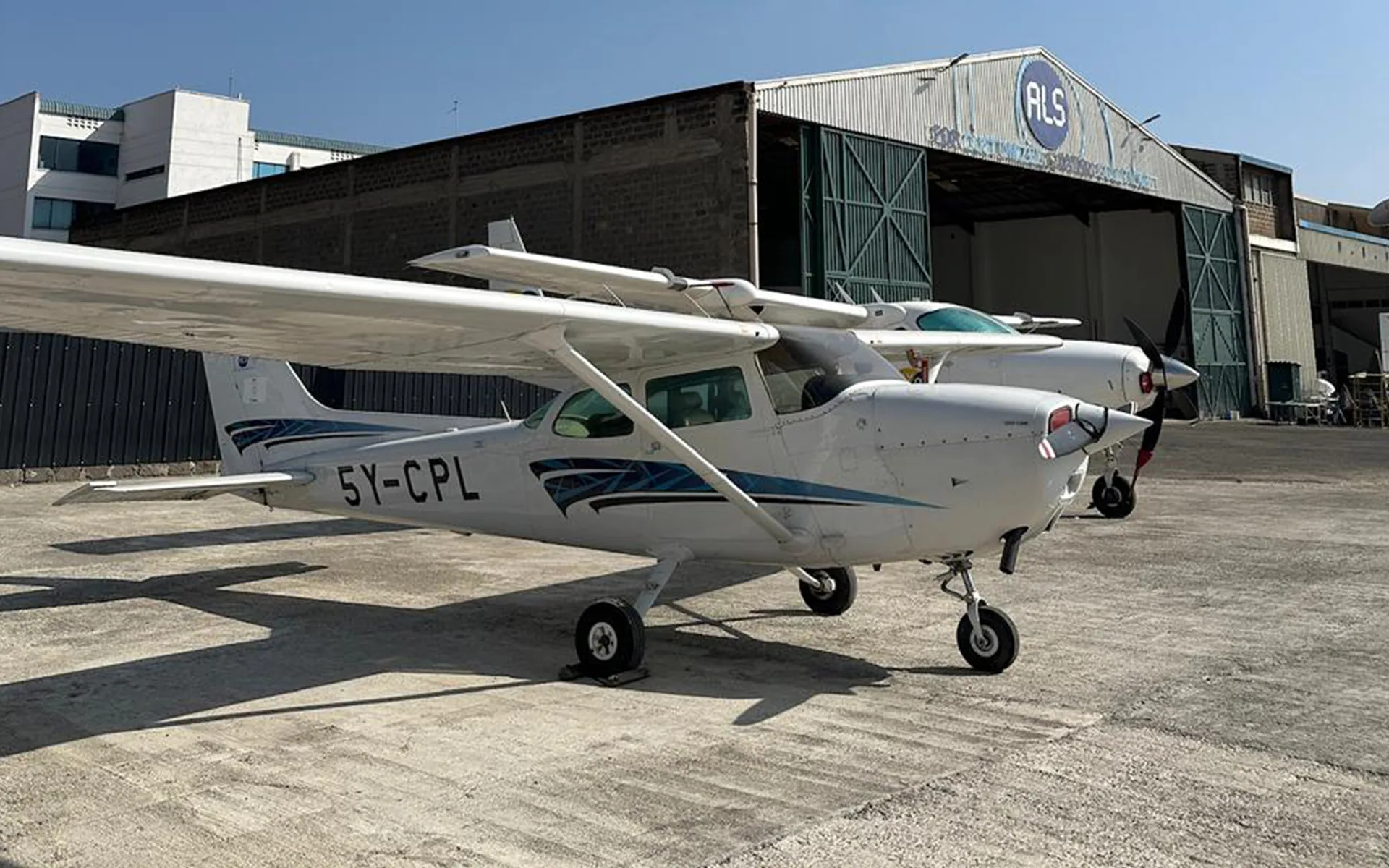
A KCAA-approved flight school at Wilson Airport, owned by the airline you might end up flying for.
The short version
ALS Flight Training was approved by the Kenya Civil Aviation Authority in April 2025. It's the only approved training organisation in Kenya owned by a commercial airline operator. Students train in Nairobi, on the same airfield as the aircraft they're aiming for, and our best graduates can go straight on to fly the Cessna Grand Caravan in ALS airline operations.
Key facts
- KCAA approval as a training organisation
- April 2025
- Private pilot licence, all in, in 4–6 months
- USD 13,100
- From no experience to First Officer on the cadet programme
- 5 phases
- Flown by our Head of Training, Captain Alessio Gori
- 12,000+ hours
How it works
The route
Selection. Tests and interviews to see if flying suits you, and you suit flying.
Private pilot licence, on the Cessna 172.
Commercial pilot licence. 150 more hours, and the theory to match.
Multi-engine and instrument rating. 20 hours in the simulator, 25 in the aircraft.
Cessna 208 type rating and hour building. Then, for the students who pass our internal assessment, a conditional job offer as a First Officer at ALS. From the Caravan, the road leads on to the 1900D, the Dash 8 and the Embraer.
Fees
| Course | Cost · duration |
|---|---|
| Private pilot licence (PPL) | USD 13,100 · 4–6 months |
| Commercial pilot licence (CPL) | USD 34,500 · 12–18 months |
| Multi-engine and instrument rating | USD 18,950 · 1–2 months |
| Cessna 208 type rating | USD 3,000 · 2–3 weeks |
Flying is charged at USD 210 an hour on the Cessna. The hours above are estimates; extra hours are charged at the same rate. Training is self-funded, paid phase by phase, before each phase starts. Prices may change.
Why train here
No conversion.
Train in Kenya for a Kenyan licence, rather than qualifying abroad and converting later, which takes time and money.
An airline next door.
Instructors, examiners and line pilots work in the same building.
Sponsors can visit.
Parents and sponsors can see progress, and the school, whenever they want.
Modern cockpits.
The trainers have the kind of avionics students will meet later on the line.
Entry requirements
Who can apply
Flight Training (open enrolment)
A C average in your O-level, KCSE or GCSE, with at least C in Maths, English and Physics. Medically fit, with good eyesight.
Cadet programme (to First Officer)
A Kenyan citizen aged 18–28, with a university degree, a B average and B grades in Maths, English and Physics. Between 5'4" and 6'2" tall. Medically fit, with good eyesight.
Questions
How much does a private pilot licence cost?
USD 13,100, all in, over 4–6 months. That includes at least 50 hours of flying at USD 210 an hour; extra hours are charged at the same rate. The full fee list is in thetraining brochure (PDF).
What do I need to apply?
For open enrolment: a C average in your O-level, KCSE or GCSE, with at least C in Maths, English and Physics, and medically fit, with good eyesight. The cadet programme asks for more: see Who can apply, above.
Does ALS sponsor students?
No. Training is self-funded and paid phase by phase, before each phase starts.
Is there a job at the end?
On the cadet programme, students who complete the Cessna 208 type rating and pass our internal assessment get a conditional job offer as a First Officer at ALS, flying the Grand Caravan. Details are in thecadet programme (PDF).
How do I enrol?
Send a CV and a cover letter to info@als.co.ke and atoinstructor@als.co.ke, with the subject "ALS ATO". Cadet applications go throughhrmis.als.co.ke.
Contact desk
Flight Training
- +254 709 078 000
- info@als.co.ke
- atoinstructor@als.co.ke
- Subject: “ALS ATO”
To enrol, send a CV and a cover letter. Cadet applications go through hrmis.als.co.ke.
Seven more ways to use it.
- Humanitarian & UNAircraft, crews and engineers for the aid world. "Go now" included.
- Wet Lease & ACMIYour flight number. Our everything else.
- Energy & MiningCrew changes and site runs, to oil-company audit standards.
- Air AmbulanceTwo stretchers, an ICU team and 3,700 km of range.
- CharterChoose the aircraft, the day and the airstrip. We'll bring the pilots.
- MaintenanceA hangar at Wilson Airport, open to other people's aircraft too.
- HelicoptersFor when there's no strip at all.